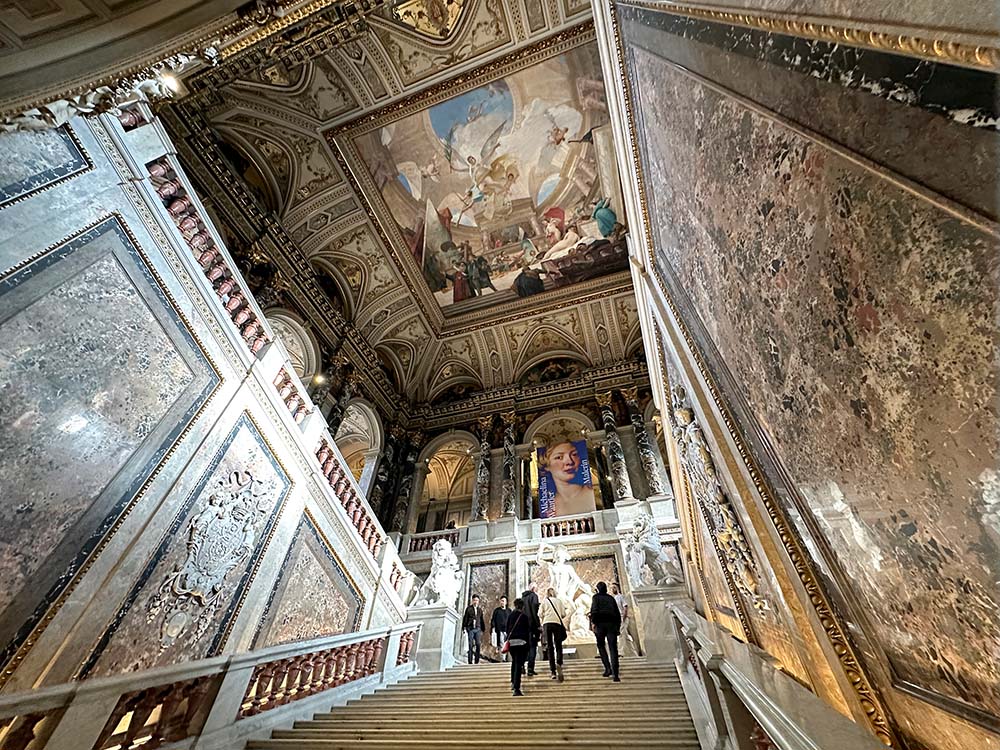
On my short trip to Austria, I visited as many museums in Vienna as I could in my few days there, but I also made some time to experience some other cool things in Austria’s capital city, from enjoying the city’s renowned classical music concerts to seeing a light projection show set unexpectedly in an old church. Along the way I popped by some traditional Viennese Coffee Houses, drank local wine in a heurige and even saw some fancy horse riding. Here’s a closer look at some of the cool Vienna cultural experiences to check out outside of the museums.
I visited Vienna with Austria Tourism, Scoot and Small Luxury Hotels of the World on a media trip. All opinions are my own.
Vienna Mozart Concert at the Musikverein: Classical Music in a Beautiful Space
When I travel, I love popping into a good museum or gallery, but music concerts have never been my thing. I think it comes with being more of a visual learner – I need to see things for it to stick; I tend to lose focus if it’s just audio, so podcasts and concerts have never really been my jam. Classical music in particular I can’t say I have much appreciation for, and the idea of sitting through an entire concert makes me twitch.
But as many people say, Vienna is Classical Music. It seems a pity to come all this way to the home of so many famous composers like Mozart, Beethoven and Strauss and not learn a little bit about them.
Part of our itinerary on this trip a visit to the Weiner Musikverein, dating back to 1870, this is an absolute stunner of a building home to the Viennese Philharmonic and best known for the Great Hall or Großer Musikvereinssaal, which is perhaps one of the most beautiful places to enjoy a concert in. Not only is the Golden Hall aesthetically beautiful, its acoustics are also renowned for being amazing and Viennese welcome in the new year with NYE concerts broadcast from this very hall.

We were in the Golden Hall that evening to watch the Vienna Mozart Concert. Now most classical music concerts are about 2-3 hours long which is a bit of a sell if you’re not a classical music fan. They’ve created shorter versions of these concerts as tasters of sorts so that noobs like myself can experience classical music without having to commit too much time. This particular concert was about 1hr 15mins long which I thought was enough to appreciate without getting bored.
While Mozart was born in Salzburg, he spent a significant amount of time in Vienna and composed many of his famous tunes here, and eventually died in the city at just 35 years old. I actually wasn’t sure how much Mozart music I knew, but I was surprised to recognise a number of these tunes! Also the acoustics of the hall were pretty amazing on its own, which is something they’ve not been able to successfully replicate in other music halls built later.
Check out everything about Mozart in Vienna, or if you want to combine visual art and music, check out my post about visiting the Secession, where the famous artist Klimt created an artwork around Beethoven’s music.


More information at the Vienna Mozart Concert website. You can also purchase concert tickets on Klook [affiliate link] [Google maps]
Votivkirche Light Show: Light Art in an Old Church
I’ve been to plenty of old churches in Europe, but a light show by night in an old church? That’s a first for me! We spent an evening at the Votive Church or Votivkirche, a neo-gothic style church dating back to the late 1800s attending a show called Light of Creation, a light projection show set within the church itself.

I’ve also seen many building projection light shows where images are projected on building exteriors, but seeing one within the church’s main aspe and nave was something quite unusual. For this show that we attended in the evening, lots of folding chairs were laid out in rows in the church’s nave – we had assigned seats and found ourselves in the center of row 32. I thought at first these were pretty good seats, but apparently this is considered a Category II seat, slightly cheaper because there was some blockage from the hanging chandeliers though I didn’t think it was a real issue.

It was pretty cold inside the church, no heating so I kept my jacket on. The show took about half an hour and basically involved light projections all over the main chapel area, the dome-shaped aspe and the surrounding pillars. It was quite cool, all accompanied with dramatic music. There wasn’t any discernible story line to my knowledge, but there were lots of different sets and graphics, I particularly liked when they had a whole section on marine animals and it felt like whales and fish were swimming up overhead, as if you’re underwater.

Read more about the Votivekirche and check out the Light of Creation website for ticket prices and schedules. Tickets cost 22-27 Euros and there may be a few show timeslots in one evening. You can also purchase tickets on Klook [affiliate link] [Google maps]
Mayer am Pfarrplatz: A Toast to Viennese Wine Heurigers
Wine is not something I associate with the Austrians until I got to Vienna – our media group had a very knowledgeable wine guy David (check out his article on Austrian wine in nearby Wachau for the Star) who introduced me to the gruner veltliner (white) and Blaufränkisch (red) which are grapes found in the Central European region, and the Gemischter Satz made out of a blend of grapes.
It was here in Vienna that I also learned that the Viennese have their own local wine drinking culture, with little taverns found across Vienna which specialise in making and selling their own wines. These taverns are called heurigers and we spent an evening at the Mayer am Pfarrplatz for dinner and drinks.
Heurigers are very localised and each district had their own taverns and types of wine. Mayer am Pfarrplatz is located in the suburban areas north of the downtown area where most of the other sites were – we had to take the tram about 30 mins from our hotel to get there.

Mayer am Pfarrplatz is quite a popular heuriger in Vienna dating back to 1683! It’s very cosy – there’s a lovely courtyard outside, but since it was cold we sat inside where it has a bit of that rustic throwback feel. There is also traditional heuriger music, with live musicians going around the tavern at intervals. It reminded me a bit of hanging out in Munich beer halls with everyone enjoying their drinks and company.

There is a wine shop on site of course if you want to bring back some Austrian wine with you, but the good news is you might still be able to pick up some of their wines in town. On my last day in Vienna, I managed to find some Mayer am Pfarrplatz Gruners in the supermarket, last minute stashes to take back home with me.


More about Mayer am Pfarrplatz. You could also check out this wine cellar tour on Klook if you’re short on time [affiliate link] [Google maps]
Eat Like the Locals at a Viennese Coffee House
Singapore has its kopitiams, Vienna has its coffee houses. These formal yet cosy cafes are an important part of Austrian intangible cultural heritage and definitely something to indulge in when you’re visiting the Austrian capital. Unlike the hip cafes of today, Viennese coffee houses are decidedly more traditional and old school, places of leisure that became popular in the 1700s where you have a cuppa while reading the newspaper and maybe playing a game of cards or pool. Chandeliers and plush seats are the hallmark of a fancy cafe, even today.
There are several Viennese coffee houses of note – Cafe Central is perhaps the most popular one where queues of tourists are perpetually trailing out the door. We took a peek in on our city walking tour but ultimately didn’t join the queue. After watching the Mozart concert, we had post-show dinner at an equally classic spot, Cafe Landtmann on the Ringstrasse.
Cafe Landtmann

Dating back to 1873, Cafe Landtmann has a lovely plush warm interior, a pleasure to enter on a cold autumnal evening! Since it was dinner time, I skipped the coffee and indulged in a new favourite: a glass of the Austrian white wine known as Gruner Vetliner, and another local classic that I love, pork schnitzel! This one was as big as my face but so good~

Cafe Tirolerhof
On an another afternoon, we found ourselves in another cute little Viennese coffee house recommended by our city tour guide, right around the corner from the Albertina museum. With over a century of history to its name, Cafe Tirolerhof had a pretty decent menu selection, but we were here just to chill for a bit so I got myself a hot chocolate… with a splash of Baileys~

Viennese coffee houses are meant for chitchat and leisure, maybe they feel a little old fashion but they also make you feel quite chi-chi when you’re sitting at a cute little table with your drink in hand. They’re definitely a nice way to rest your legs after long hours at the museum or just to warm up when it’s too cold outside…

Other recs from our guide that we didn’t have time to check out: Cafe Frauenhuber is apparently the oldest coffee house in Vienna, Cafe Leopold Hawleka is another old famous name – nearby is Trześniewski, not a Viennese coffee house but they serve up Polish-style open sandwiches that have become a Viennese institution over the last 120 years!
Spanish Riding School: Imperial Traditions on Horseback
One of the more unexpected things on our Vienna itinerary was spending a morning at the Spanish Riding School. Part of the Hapsburb empire and Vienna’s imperial history is its long association with fancy horses and dressage, which basically involves horses executing fancy footwork and moves. It may be called the Spanish Riding School, but this practice is another long storied Viennese tradition dating back to the mid 1500s. The Spanish name comes from the fact that the early stallions bred and trained here were imported from Spain, today the beautiful white horses are known as Lipizzaners.
The Spanish Riding School is located in the Winter Riding School, part of the Hofburg Palace right across the way from the Sisi Museum and this is perhaps the most beautiful riding hall with its ornate ceilings and walls.
Typically most people want to watch the main Performance, which sees trained riders executing different moves and tricks with their horses, but the shows only take place on Sundays at 11am, so we had to settle for watching the Morning Exercise instead where we watch riders take their horses out for some exercise and training.
I think that you need to be a real horse girl to appreciate it because the morning exercise takes about an hour, and you watch two different groups run the horses through their paces, but it’s not particularly exciting. You also can’t expect any fancy tricks or performances, it’s mostly just horses cantering or trotting fancily around. At least the venue is super pretty, but you aren’t allowed to take photos or videos of the training or horses, so no pix of that happening unfortunately~

What was cool was taking the guided tour after the morning exercise to see the behind the scenes areas of the Spanish Riding School! We were led past the crowds gawking from the public area to the main courtyard of the stables, where we learned more about how the Lipizzaner horses are bred, taken care of and trained. We got a peek into the tack room (they have such fancy gear), learned about their intricate naming system and lineage dating back to the 1500s, and even got to selfie with some of the more cooperative horses. I definitely found this bit more interesting, and I think if you pair it with the actual show, would make you appreciate the performances a lot more.
Something that I thought was interesting – the fancy tricks (e.g. like the horse standing on its back hind legs) are not so much taught, but encouraged only in horses that can do the tricks. It’s something stallions do naturally to intimidate other horses, but they don’t actually force horses to learn how to do it if they’re not already inclined to do so.


Get your Spanish Riding School tickets here. You can purchase the performance tickets or training sessions on Klook [affiliate link] [Google maps]
I visited Vienna with Austria Tourism, Scoot and Small Luxury Hotels of the World on a media trip. All opinions are my own.
There’s still so much more of Vienna and Austria to see, tell me what I missed out on! In the meantime, check out my other posts on Austria: