
SINGAPORE: The war in the Middle East is no longer a distant conflict for Southeast Asia, it is hitting our wallets, supply chains and economies across the region. Since fighting erupted on Feb 28, disruptions to oil flows through the Strait of Hormuz have pushed fuel costs sharply higher, exposing how dependent many Southeast Asian nations are on Gulf energy. From rising transport costs to weakening currencies and looming inflation, the impact is uneven — and in some countries, already severe.
The region has been especially hard-hit. SEA is largely dependent on the oil that comes from Gulf states, while the United States and Europe have more diversified supply routes for their fuel needs.
Diesel and jet fuel prices in Asia have spiked even faster than the price of crude oil, due to high demand and tight refining capacity. Some Asian currencies have become weaker, and because the price of oil is in US dollars, it now costs them more to buy oil.
With higher prices of fuel, people are driving and commuting less, but this is likely to be followed by broader inflation, including higher food and electricity prices.
However, how the different nations in Southeast Asia differs depending on several factors, including resources and governance.
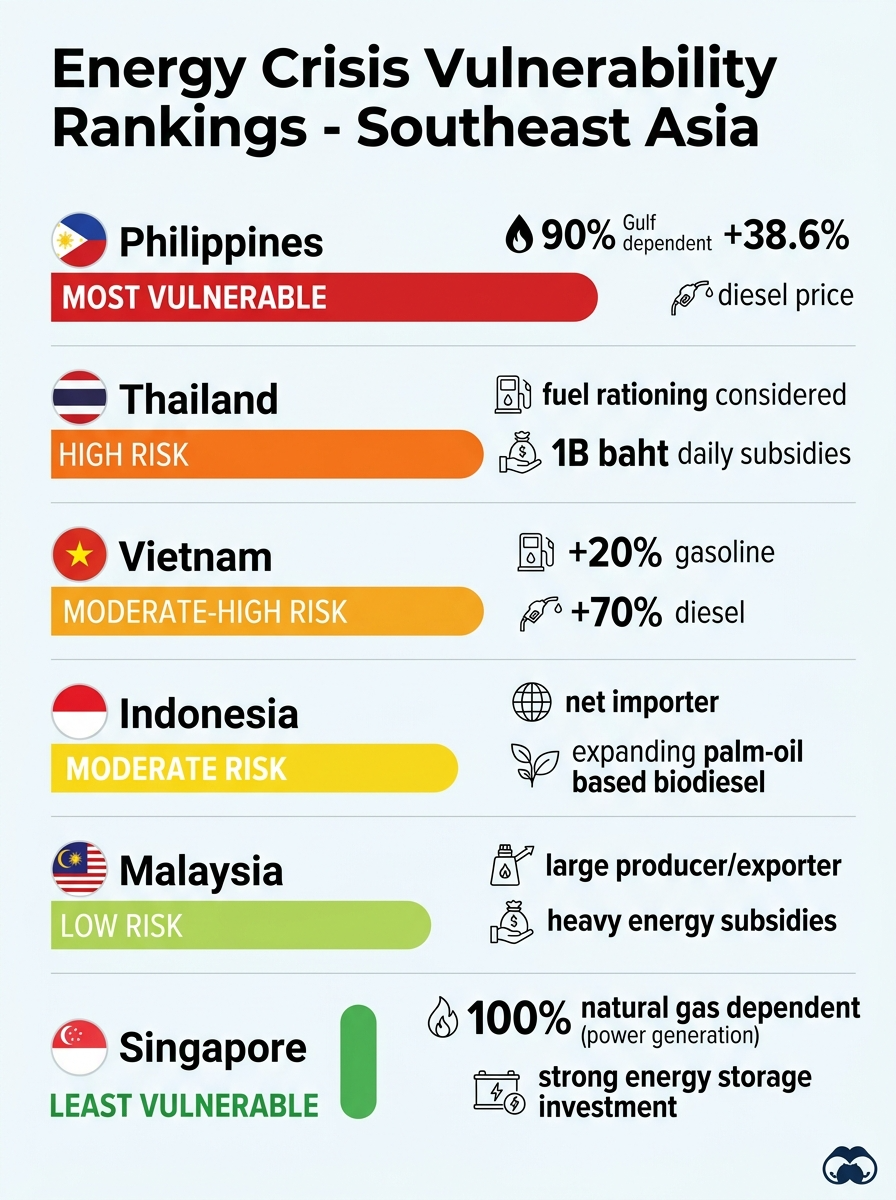
Southeast Asia Energy Vulnerability
Vulnerability rankings
The Philippines is probably the most vulnerable country in the region, as the country is dependent on the Gulf for 90% of its needs, has limited buffers, and a weakened currency. For the first time last week, the Philippine peso dropped to PHP60.1 to US$1 (S$46.75). The price of diesel, meanwhile, has gone up by 38.6%, and higher electricity prices were already announced even before the war broke out.
Public transport drivers have complained that they are now taking home far less money than before Feb 28, with one telling The Guardian that his earnings are less than half what they were. Cebu Pacific, one of the local carriers, announced on March 24 that it is cutting flights due to the high price of fuel.
Next in line is Thailand, which also imports large amounts of oil and has limited domestic reserves. There has been a spate of panic buying of fuel. The Thai government is now considering rationing fuel and closing petrol stations, as well as freezing LPG prices and expanding subsidies, which is already costing it 1 billion baht (S$39 million) each day.
Vietnam has also seen sharp fuel price spikes, and, as a fast-growing economy, has large energy needs. The price of gasoline has gone up by 20%, and diesel has seen a 70% uptick. There has also been an increase in transport and delivery costs, food and imports, as well as disruptions to the tourism industry.
Indonesia is faring somewhat better as it has stronger buffers with domestic energy resources, but the country is still a net importer of oil. It is now expanding its palm oil usage to reduce imports. Like other countries in the region, it faces inflation pressures, but unlike them, Indonesia has yet to see a large spike in fuel prices as the government seeks to shield consumers.
Malaysia is one of the few net energy exporters in the region, and higher oil prices are, in that way, good news for the country. However, inflation is affecting Malaysia as well, especially with higher food and transport prices, and job security might also prove to be a challenge. Nevertheless, prices in Malaysia are not rising nearly as quickly as in neighbouring countries.
Singapore is arguably in the best position in the region. While it imports fuel, it is a wealthy country with a strong currency as well as reserves. However, the price of fuel is up, and logistics and shipping costs have also increased significantly, and low-income families will be among the most vulnerable in society.
Nevertheless, because Singapore does not exist in a vacuum, it will be affected if a regional energy crisis occurs. /TISG