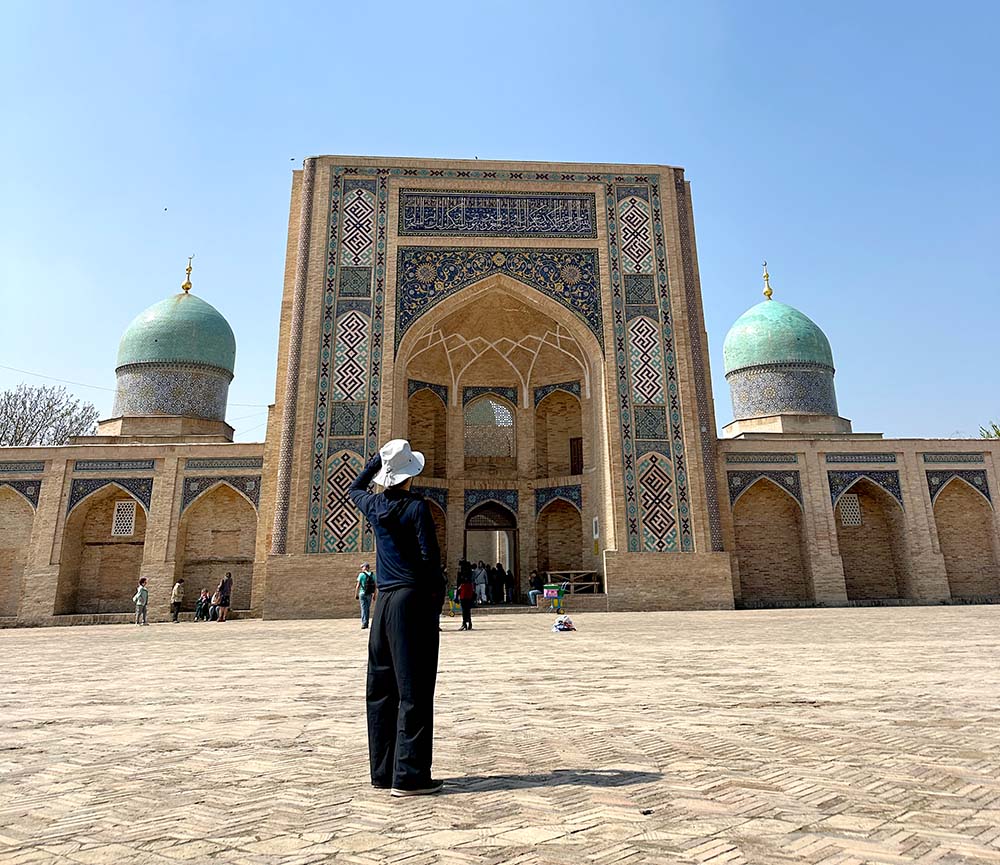
The ancient city of Bukhara was my introduction to Uzbekistan and a great way to kick off ten days of independent travel around the country. From majestic ancient architecture around the old city to bustling marketplaces and delicious Uzbek food, I thoroughly enjoyed by time in this very walkable old city. Here’s what we did in our 3 days in Bukhara for anyone planning to explore Uzbekistan on their own.
While I usually travel solo, on this trip I was travelling with friends, and while we had a mandatory tour guide in Turkmenistan, we sorted out our transport and accommodation on our own in Uzbekistan, only getting guides when we did day trips out of the city and to Tajikistan.
Read my independent travel tips for Uzbekistan.
Things to do in Bukhara
With over 2,000 years of history, the old city of of Bukhara has been recognised as a UNESCO world heritage site. It was one of the most significant Islamic cities along the Silk Road from the 10th-17th century and managed to preserve a lot of its original history and monuments. I thought it was a nice city to start out exploration of Uzbekistan in that was easy to get around and a nice mix of architecture to check out.
Bukhara’s old city is pretty walkable and our hotel was located not far from the Po-I Kalyan Complex and the main sights downtown. The only time we took a Yandex taxi in Bukhara was to go to the train station to take the high speed rail to Samarkand.
One thing to note about the names of places in Uzbekistan – there isn’t a lot of consistency in spelling, so something like Hauz can get spelled as Howz, Haus, even Khause on maps, so have a bit of flexibility when searching for places!
Check out my friend Oheyjelly’s Bukhara vlog for more! We were on the trip together and it’s always awesome to see how we experience the same places in similar/different ways!
Samonids Recreation Park
Samonids Recreation Park is a beautiful patch of greenery, a nice break from the dusty urban landscape and many madrasahs, mosques and markets that you’ll see throughout Bukhara and Uzbekistan.
We found ourselves in Bukhara on Nowruz, which is basically the Persian New Year that’s celebrated throughout Central Asia. Because it’s a public holiday, we found Samonids Recreation Park a lot more crowded than usual and with a funfair in full swing when we visited.

Ismail Samani Mausoleum
Located within Samonids Recreation Park is a rather unassuming landmark with a surprising claim to fame. The Ismail Samani Mausoleum or Samanid Mausoleum may not look particularly impressive compared to the other larger and more colourfully decorated architecture around the city, but it dates back to the 10th Century when Bukhara was the the centre of the Samanid Empire and is perhaps the oldest intact Islamic-style mausoleum around.
You can go inside if you want but it’s paid entry and I don’t think the ticket was too expensive, but honestly it’s so small you can see most of it from the windows/doorways. Also, we were mostly here because my friends are avid geocachers and there is a well-hidden spot around here!

Ismail Samani Mausoleum (Somoniylar Maqbarasi) [Google map]
Bukhara Central Bazaar
Bukhara’s Central Bazaar is a sprawling complex not far from the Samonids Park and it is busy in just about every corner and feels very local. It feels like vendors here have just colonised any free space that they can find as there’s so much to see here – some bits had Russian architectural feels, other bits were a bit more rundown.
You can buy all manner of food and sundries at the bazaar, and it often is one of the best/cheapest places to pick up local produce and snacks and you can even sample food as you walk around. You can also find lots of amenities around here – many ATMs to withdraw money and a conveniently placed Ucell where we could pick up a SIM card – more on that in my Uzbekistan trip planning post.


Bukhara Central Bazaar [Google map]
Bolo Hauz Mosque
This mosque is the only surviving building in Bukhara’s Registan square and dates back to the early 1700s and has some really beautiful detail. Since it was Nowruz, the Bolo Hauz Mosque was pretty busy with worshippers spilling to the exterior during prayer time.


Though we couldn’t go inside the mosque, the outside verandah (known as an ayvan) is very typical of Islamic architecture, and this one had lots of old weathered wooden pillars and a very decorated ceiling.


Outside the mosque is the Hauz (or Khauz), aka the symmetrical pond. These were once water sources for the people of Bukhara and the city was filled with them. Unfortunately they were also causing diseases to be spread so most of these ponds were removed.

Bolo Hauz Mosque (Bolohovuz masjidi) [Google map]
Ark of Bukhara
Right by the Bolo Hauz Mosque is the Ark of Bukhara, a massive fortress and the main residence for the Emir of Bukhara back in the day. Today it’s the most prominent monument of the city and one of the city’s oldest structures dating back to the 5th century.


You need some time to explore because this place is super large and there are several museums within the compound showcasing a mix of old artefacts like maps, clothing, coins, books and more.


The citadel is quite high up so you can get a nice view from the outdoor spaces. You can also find several shops in the various areas. It’s something that you’ll find in a lot of Uzbekistan’s old buildings, people just setting up shop somewhat randomly in a part of the throne hall or former stables.

You can even find a whole archaeological dig area on one part of the fortress. I like the signs that recreate what the ruins might have looked like back in the day. Great views but man this was not very sheltered at all so it was hot.

I came across this one guy doing live watercolour paintings on postcards and decided to get one – it cost me 60,000 som which is basically the price of my ticket in here (about S$6.50) but I thought it was pretty!


The square outside the Ark is pretty touristy, with camels that you can pay to pose with and cyclos to pedal around the massive plaza area. We were here mostly because there was an ice cream shop and we needed to cool down!

Ark of Bukhara (Buxoro arki) [Google map]. Entrance fee 60,000 som
Po-I Kalyan Complex
Another of Bukhara’s main sights is the Po-I Kalyan Complex in the center of the old town. The Complex actually consists of several different areas and buildings.

The oldest portion is the Kalyan Minaret, a tower built in the early 1100s that’s about 46m tall. Apparently you used to be allowed to climb up but not when we were there. It used to be called the Tower of Death because they threw prisoners from the top!

We could enter the Kalyan Mosque compound though, which had a very large courtyard that we wandered around in. Originally built around the same time as the minaret, the mosque was destroyed in rebuilt in the 1500s and meant to look like the massive Bibi Khanim Mosque in Samarkand. This was our first of many encounters with Uzbekistan’s blue islamic architecture, with several impressive arched iwans around the perimeter.


There is another building opposite the mosque – the Mir-I Arab Madrasah or religious school – which is marked by its twin turquoise domes, but it was undergoing renovation so we didn’t go in.

We had a walk around the Po-I Kalyan Square at night as well and it’s lit up very prettily, so definitely make sure to see it after sunset.

Po-I Kalyan Complex [Google maps]
Abdul Azis Madrasah & Ulugh Beg Madrasah
Not far away from Po-I Kalyan Complex is another pair of madrasahs. The Abdul Aziz Madrasah is named after one of its former khans or rulers, and probably my favourite building in Bukhara because of its vibrant colours and intricate detail.
Abdul Aziz Madrasah is much more vibrant than its opposite neighbour Ulugh Beg even though the latter is arguably more significant – Bukhara’s Ulugh Beg Madrasah is apparently the oldest preserved madrasah in Central Asia and the blueprint for the ones that came after! We didn’t go into the Ulugh Beg Madrasah, but we popped into Abdul Aziz Madrasah.


We walked inside the madrasah and it’s filled with small little shops selling all manner of souvenirs like paintings, clothing and other knickknacks.


Abdulaziz Madrasah [Google maps]
Lyabi Hauz and Nadir Divanbegi Madrasah
Another area in Bukhara that we spent our evenings in was Lyabi Hauz. The Hauz or water pool here was once part of the city’s extensive canal system and is one of the last remaining ones in the city after the rest were removed because of waterborne diseases.
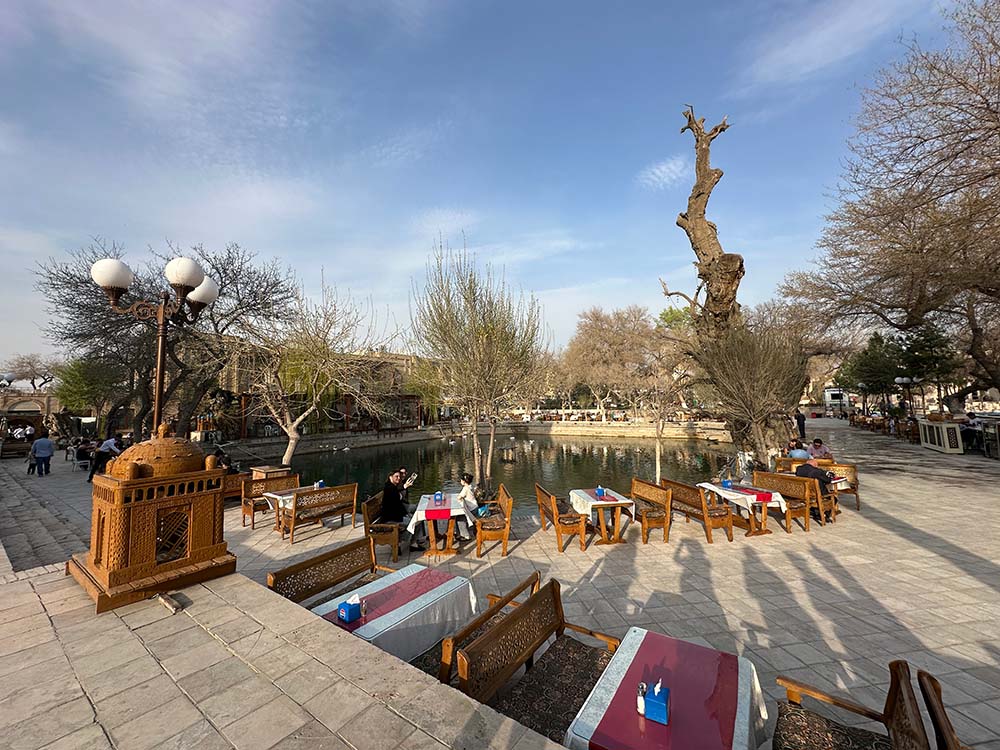
The plaza is especially happening in the evenings when it’s a bit cooler and there is dining out in the open. We were here on the weekend and they even had some sort of impromptu dance party happening in the square.

The Lyabi Hauz Ensemble has a collection of more mosques and madrasahs. Of note is the Nadir Divanbegi Madrasah – named after its builder, this was a caravanserai before being converted into a religious school, recognised by its very distinct facade. The entrance arch is a vibrant blue flanked by two green simurgh birds and a weird sun with a face.

We spotted a lot of people taking photos with the statue of Khodja Nasreddin in front of the building. Think of him as a local folk hero who went around the countryside on his donkey causing hijinks and helping out the common people by ridiculing the elite class.

Lyabi Hauz / Lyabi Khause [Google maps]
Chor Minor
We took a short walk east of Lyabi Hauz. This area seemed much quieter overall and lots of construction was happening on the streets. Here we found a very cute building called Chor Minor. The name Chor Minor means ‘Four Minarets’ which are pretty evident upon looking at the building. It’s shape is quite unusual for Uzbekistan architecture.

Chor Minor is interesting because it’s not one of the typical M buildings – not a madrasah, mosque or mausoleum. This instead was a gatehouse to a former madrasah that doesn’t exist anymore. And despite the fact that they are called minarets, those towers aren’t used for prayer call and are in fact storage areas. Only one of them has a spiral staircase connecting the roof to the lower floor.
None of my companions were interested to check it out, so it was only me who paid 15,000 som (about S$1.60) to traipse up the narrow spiral staircase. The ground floor had some shops and a lady who you pass the money to.

On the upper level was an empty room – it’s not decorated or used for much, so I kept climbing up to the roof of Chor Minor.

Tadah on the roof! It’s not really meant for walking around too much as there were beams and kerbs all around, but you do get a better look at the cute little salt-shaker type roof. There is even a fake stork nest on one of them – storks used to be common in Bukhara when they had all their pools, and you could find nests on every roof. The storks disappeared when the pools were removed because of diseases, and the fake storks/nest are just a reminder of that history. You will see storks in the scissors sold in these parts which are shaped like storks!


Chor Minor [Google maps]
Where to eat in Bukhara
Bukhara was our first stop in Uzbekistan and our introduction to Uzbek cuisine! The vibes were definitely very different from Turkmenistan being a much more modern and bustling city, but we found some pretty good dining spots that I’ll recommend here.
Joy Chaikana Lounge
Because of the holiday, we couldn’t visit the first time we it was fully booked, but we made a reservation for the following evening and were we glad we came back. I think Joy Lounge was some of the best food we had in Bukhara and all of Uzbekistan! This restaurant is in the Lyabi Hauz area and doesn’t look that big on the outside, but man it’s quite impressive inside.


Plov or pilaf is one of THE foods of Uzbekistan and we would have many versions of it across Uzbekistan, but this one is so special it requires a 2 hour pre-order (we ordered when making our reservation the day before), but so good with tender beef and yellow carrots! The chicken thigh kebabs here are also juicy and yummy.
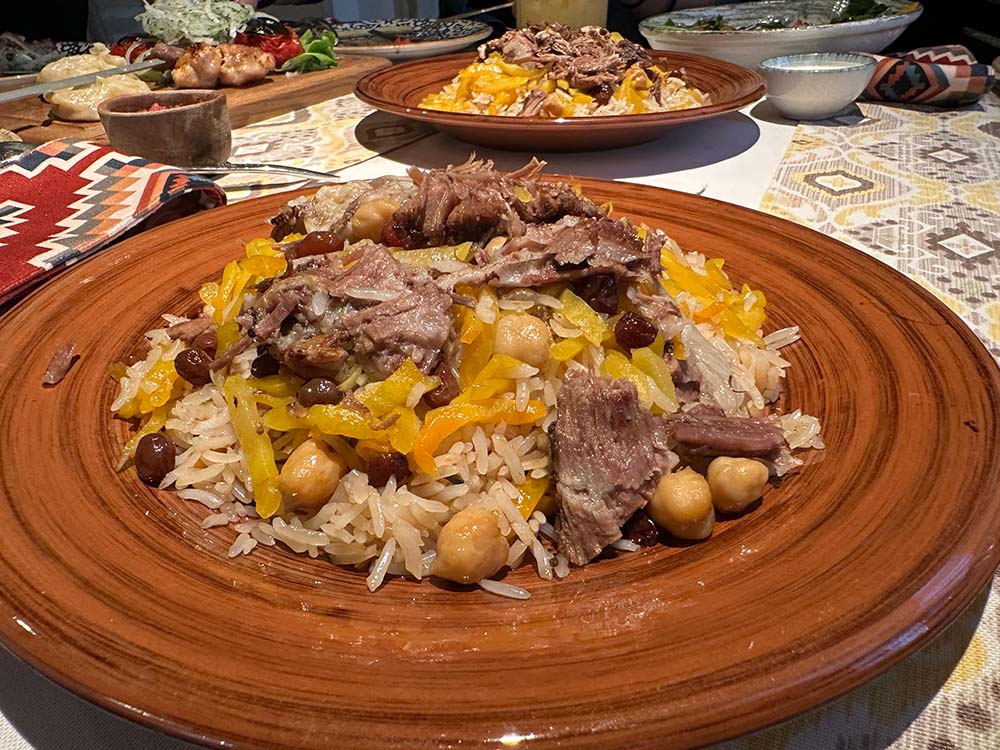
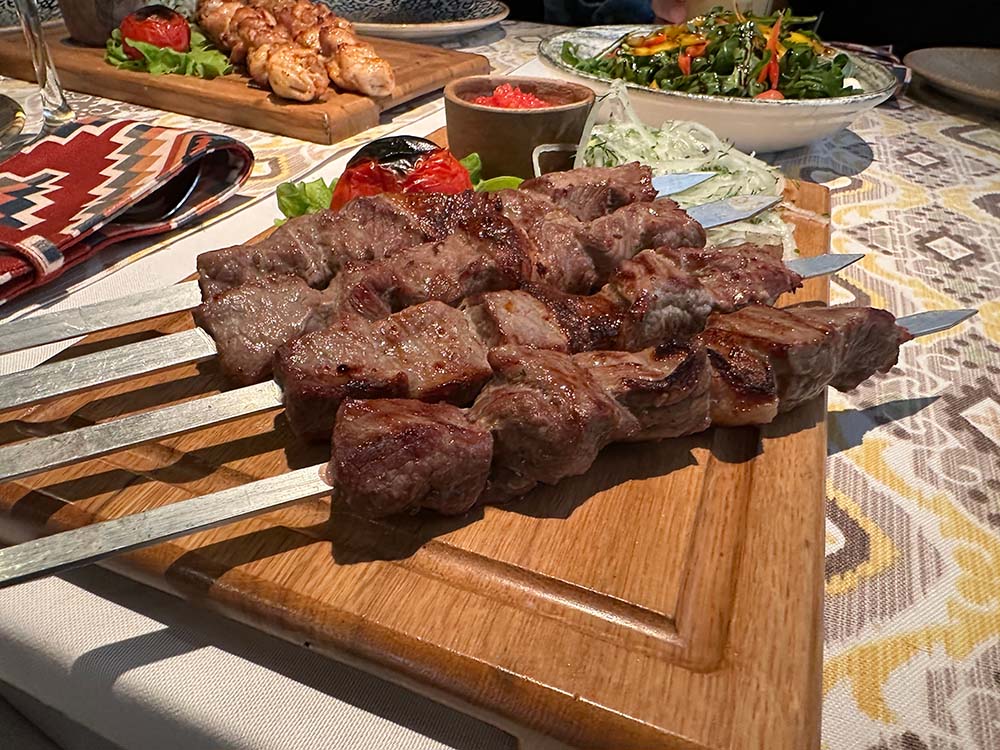
We had quite a lot of food shared amongst 5 people, and each of us paid about 140,000 UZS (about SG $15), which is very decent given that thi sis quite a nice restaurant, good food and service (no service charge!)
Joy Chaikana Lounge [Google maps]
Ayvan
Our first night we ended up eating at Ayvan, a more fancy restaurant hidden away just off the main Lyabi Hause area. Ayvan if you remember from above, is a reference to the high roof decorated terrace, and obviously this one was very beautiful – the house once belonged to a very rich merchant who had a fairly famous architect of that time build him this property which is now home to the Lyabi House Private Hotel.

We chose to sit inside, but they’ve really outdone themselves with the beautiful decor. I love all the carved wood and decorative tilework.

This was a more upscale restaurant so we decided to indulge in some steak and Uzbek wine! Nuara is a nice red on the dry side.


For 5 of us each with our own version of steak and a bottle of red wine, the cost split 5 way came up to 256,000 UZS which is about S$28. Not the cheapest but still pretty decent price given what we ordered!
Ayvan [Google maps]
Sitora Kafe
Some places we chanced upon by accident. It was blazing hot during our time in Bukhara, so for lunch we found somewhere convenient to pop into not far from the Ulugh Beg and Abdul Aziz madrasahs. Sitora Kafe honestly doesn’t look like much from outside but their homestyle fare was quite good~

We tried a dry version of Lagman – we had the soup version the day before, but this stir fried dry version was surprisingly good. Kinda mee gorengish. Also a very heartwarming Matstava – meaty soup with rice and of course, beef kebabs.


For 5 of us, we each paid about 32,000 UZS (S$3.50) each, so again, very affordable meals!
Sitora Kafe [Google maps]
Where to stay in Bukhara
Duston Boutique Hotel
We booked our hotel before the trip via booking.com. Duston Boutique Hotel is a lovely little place and very centrally located – a 5 min walk to Lyabi Hauz and about 10 mins walk from the Kalyan complex.

It looks quite plain outside, but the inside is quite lovely, with the traditional style Islamic style decor and a slightly modern feel. There are some day beds outside where you can hang out in the courtyard if you wish.
The rooms are quite comfortable as well, and this hotel was quite popular so I ended up booking the last available room which was a more premium room for 3 pax with a bathtub (the other people on my trip were 2 couples who each booked twin rooms). However because we arrived pretty late (that border crossing from Turkmenistan took some time) and the guy at the reception was very new and green, so all our rooms ended up mixed up and I ended up with a twin room (one of the couples got my fancier room with the bathtub) which honestly, was still very comfortable. Getting that sorted out took a bit of arguing and negotiation, but in the end they gave me a bit of a refund.
But other than that mini mix up, honestly I’d come back here again because it was comfortable, convenient and a pretty hotel to boot, and generally the service was quite good.


Hotel breakfast was in the restaurant in the basement which was cosy and had a good spread of colr cuts, fruits and pastries.

Cost wise, my premium room would have cost about S$350 for 3 nights (about S$110+/night), but because of the mix up and all, I ended up paying a cheaper rate because they refunded me a bit. If I had booked the twin room, the rates would be somewhere around S$80-90/night.
Check out Duston Boutique Hotel on booking.com [affiliate link]
Looking to explore more of Uzbekistan? Check out my Uzbekistan posts for more: